Why Every Kingdom in Fantasy Is Already Cracking
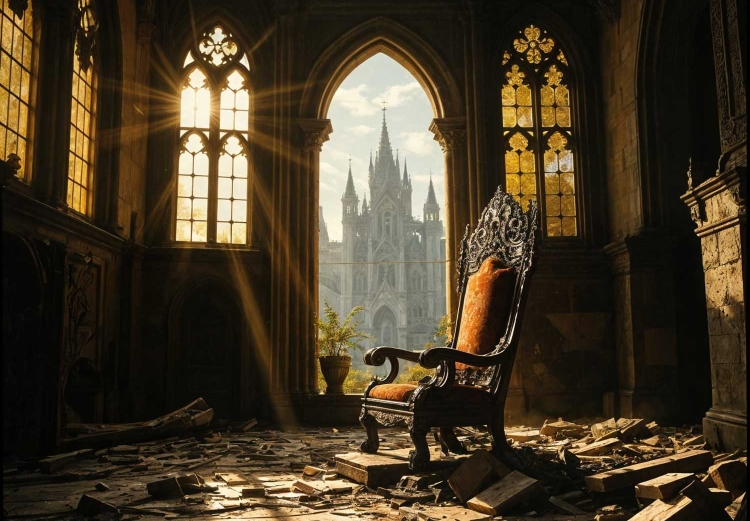
Here's something nobody says out loud, but every fantasy reader feels: the kingdom is always the problem.
Not the dragon. Not the dark lord massing his forces beyond the Ashen Mountains. Not the ancient curse slowly turning the river to blood. Those are symptoms. The kingdom, the gilded, flag-flying, lineage-obsessed institution at the heart of nearly every epic fantasy ever written, is the wound beneath all the others. And it arrived broken.
We don't always notice, because we're too busy rooting for it.
The Throne Was Built on a Lie
Think about how kingdoms in fantasy actually come to exist. Someone, usually called the First King, the Founder, or the Unifier, did something violent and then declared it sacred. They won a war and called it destiny. They seized land and called it inheritance. They killed rivals and wrote history books.
This is not cynicism, it's just how political power works, and the best fantasy writers have always known it. Tolkien knew it. His kings are haunted men, heirs to catastrophes, trailing the long shadow of Númenórean hubris into everything they touch. George R.R. Martin knew it with such relentless thoroughness that readers spent fifteen years waiting for him to find a way out. Even C.S. Lewis, for all his moral clarity, couldn't quite make Narnia's royalty seem like anything other than an imported colonial idea dressed up as liberation.
The founding violence doesn't go away. It gets inherited. It sits in the bloodline like a rogue gene, waiting for the wrong century to express itself.
The Structure Demands Catastrophe
A monarchy is an inheritance machine. And inheritance machines have a fatal design flaw: they cannot guarantee the fitness of what they pass on.
A kingdom built around the divine right of a single bloodline will, eventually, produce a king who is a child, or a coward, or a sadist, or simply mediocre, and mediocrity at the top of a rigid hierarchy is catastrophic in ways that mediocrity anywhere else simply isn't. The system cannot self-correct. It can only crack.
This is why fantasy is so obsessed with succession crises and disputed heirs. It's not because fantasy writers lack imagination. It's because the structure itself produces these crises as reliably as a factory produces goods. The kingdom doesn't need an enemy. It just needs time.
Add to this the accumulated weight of every policy decision, every noble house that was promised something and not delivered and every border agreement that made sense in one century and became a grievance in the next, and you have a system that is not waiting to be broken by external force. It is slowly, methodically breaking itself.
The Map Is Always Lying
Look at the map in the front of any fantasy novel. There it is: the clean borders, the named regions, the orderly coast. The kingdom looks solid. It looks like a fact.
But borders in the real world and in the best imagined ones are negotiations, not lines. They are agreements held in place by force, or by mutual benefit, or by the exhaustion of everyone involved. Remove any one of those conditions, and the border stops being a border. It becomes a front.
The great fantasy kingdoms are always larger than they can actually govern. The march territories are always restless. The mountain clans were incorporated by treaty rather than by loyalty, and they remember the difference. The city that was conquered three generations ago still conducts its trade in the old language and still has saints that the crown has never officially recognised.
The map shows what the king claims. It does not show what the king controls. Those are, in every fantasy kingdom worth its salt, two very different things.
The Allies Are Only Allies Until They're Not
No kingdom stands alone. It stands on a web of alliances, trade agreements, marriage compacts, and old favours, and every single one of those threads has a breaking point.
This is where fantasy becomes genuinely instructive about power, if you're paying attention. The ally who sends troops is calculating what they'll receive in return. The noble house that swears fealty has its own ambitions, its own debts, its own younger sons who need something to inherit. The church that lends legitimacy to the throne has its own idea of who should be directing policy, and it is patient in ways that kings are not.
Fantasy kingdoms tend to treat alliances as solved problems, as backstory. The wise fantasy novel treats them as ongoing negotiations that could collapse at any moment, because that is what they actually are.
When the crisis comes, and it always comes, the kingdom discovers how many of its alliances were genuine and how many were merely convenient. It is rarely encouraged by what it finds.
The Magic Is a Political Problem
In worlds where magic exists, it is seldom politically neutral.
If magic runs in bloodlines, then the magically gifted aristocracy has a justification for its power that is harder to argue with than birth alone, and a corresponding terror of what happens when someone outside the bloodline manifests the gift. If magic must be trained, then whoever controls the academies controls who gets power and who doesn't, which is not a school policy: it is statecraft. If magic is wild and sourceless and can emerge in anyone, then every kingdom's hierarchy is sitting on top of a potential revolution it cannot fully predict or suppress.
The magic system is always, at its root, an argument about who gets to be extraordinary and what the rest of the world is supposed to do about it. That argument never gets settled. It just gets deferred, sometimes for centuries, until a protagonist shows up.
What This Means for the Stories We Love
None of this is a criticism of fantasy kingdoms. It is the opposite.
The reason these structures compel us, the reason we keep returning to throne rooms and succession crises and the careful diplomacy of the small council, is precisely because they are cracking. A stable, well-functioning political entity is not interesting. A kingdom at the moment of its stress test, when all the contradictions built into its foundations are finally being asked to bear the load they were never designed to carry, that is where the story lives.
The best fantasy writers do not give us kingdoms to admire. They give us kingdoms to understand. They build the cracks into the architecture so that when the breaking comes, it feels not like an interruption of the world, but like the world finally becoming honest about what it always was.
Every kingdom in fantasy is already cracking because every kingdom worth writing about contains, within its own logic, the reasons it cannot last.
That is not a flaw in the genre. That is the genre's greatest strength.
The cracks are where the light gets in. They're also where the story begins.