Writing Political Tension Without Endless Exposition
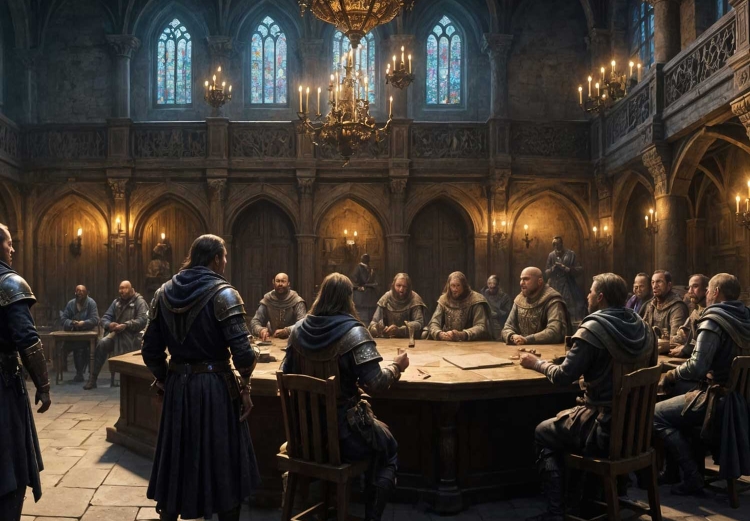
There is a particular kind of reader dread that comes from opening a fantasy novel and finding, in the first thirty pages, a genealogy table. Or a council scene in which seven lords explain the recent history of their rival houses to each other. Or a map that references seven kingdoms you will never visit but are apparently required to know about. The author has built an elaborate world of political intrigue, and then, unsure the reader can find their way through it, has handed them a guidebook instead of a story.
The irony is that court intrigue, scheming nobles, and shifting alliances are among the most gripping things fiction can do. At its best, it gives us Hilary Mantel's Wolf Hall, where every meal, every glance, every carefully chosen seat at a table is a political act. It gives us Game of Thrones before the plotting ran out of novels to draw from. It gives us the cold, brilliant manoeuvring of Dostoevsky's court scenes and the social menace threaded through every Jane Austen drawing room.
What these works understand, and what many aspiring fantasy writers do not, is that political tension does not live in information. It lives in pressure.
The Exposition Trap
When writers build an intricate court world of factions, bloodlines, and ancient grievances, the temptation is to front-load the reader with context. Surely they need to understand the political landscape before they can appreciate the stakes?
The answer is: not yet, and probably never as much as you think.
Mantel never pauses Wolf Hall to explain the Tudor court's factional dynamics in abstract. She drops us into Thomas Cromwell's mind as he reads a face across a room, and we learn everything we need from the quality of his attention. Joe Abercrombie's The Blade Itself introduces the sinister Inquisitor Glokta not through a summary of his politics but through the specific, horrible texture of his daily life and within a chapter, we understand his world completely.
The lesson: readers are extraordinarily good at assembling political context from scene and action, if you trust them with it.
Pressure, Not Briefing
The most effective scenes of court intrigue are built on what characters want, what they cannot say, and what they fear will be seen. These are conditions of pressure, not information delivery.
Consider how this works in practice. In The King's Fall, Baron Gorgo announces his ambitions not through a monologue about his political programme but through a single, loaded toast at dinner: "To old blood and new beginnings." The court laughs. The King does not. And Princess Eloise, watching her father's reaction, understands in that moment that Gorgo has made a move — not toward her, but toward the throne itself. What follows is not an explanation of what the toast meant but an image: Gorgo, later that evening, wearing the signet of Eloise's great-grandfather. A piece of jewellery. A wordless statement that outdoes any speech.
This is political tension working as it should: through objects, behaviour, and implication rather than declaration.
The same novel gives us a wonderful example in Gorgo's corridor encounters. He moves through the castle's hallways and forces minor nobles to step aside. He plucks bread from a servant's tray and holds the girl's gaze while he eats. He corners a servant boy and sends an oblique threat to the Court Mage through him. None of this requires us to know the precise political hierarchy of Ardanthia. We know what we need to know because we can feel the weight of the man — and that weight is political.
Let the Watcher Watch
One of the most underused techniques in court fiction is the third observer: a character positioned to see what the principals cannot, who reads the scene for the reader without narrating it.
Mantel's Cromwell does this constantly. So does Le Carré's Smiley. The reader inhabits a consciousness that is perpetually watching, evaluating, and inferring, which is far more engaging than being told what to think.
In The King's Fall, this role is played with particular elegance by Crown Warden Seraphina D'Argent. Positioned in the colonnade's shadow as Princess Eloise meets Prince Evander in the rose court, she observes their encounter with "the dispassion of a hawk surveying a field." Where a less confident writer might have given us a summary of the political implications of this meeting, Seraphina simply watches and notes the distance between their bodies as "both invitation and rebuke," files away the mention of Baron Gorgo's name, and catalogues every adjustment of posture. We don't need the author to tell us this encounter is dangerous. Seraphina already knows it, and her knowledge becomes ours.
Later, when Seraphina departs this vantage and speaks to Evander, she does not brief him. She warns him. The distinction matters enormously: "You were seen. I know. But only by you. You flatter me, Highness. The kitchen staff are not as deaf as they pretend." In three exchanges, she has conveyed that he is under surveillance, that his confidence is naive, and that she is the only thing standing between him and disaster. No exposition needed.
Subtext Is the Text
The most sophisticated court scenes run on what is not said. Meaning accrues in the silences, the deflections, the overly careful compliments.
Think of the banquet exchanges in The King's Fall between Lady Veyra and Lord Merrow. They are ostensibly discussing trade, the Nerathene galleons, and the question of Eloise's loyalties. But every line is a probe and a parry. When Merrow asks Veyra about the Princess - "Will she favour war or peace, when the time comes?" - she answers obliquely: "She will favour survival. Which is more than I can say for the men in this hall." It is a non-answer that tells us precisely where Veyra stands, without her ever having to declare a faction.
When Merrow reaches across the table and closes his hand over her wrist - "If you have allies, Veyra, choose them wisely" - she does not break from the tension. She meets it: "Do not mistake my restraint for passivity." This is a negotiation conducted entirely in the language of implication, and it is far more electric than any scene in which two characters explain their interests to each other.
The same dynamic carries into Twilight's Dominion, where Lysandra Vale, the new Caladornian Ambassador, deploys warmth and its withholding as instruments. Her bow to the Queen is calculated to the millimetre: "enough to acknowledge, but never to supplicate." When the Nerathi ambassador tries to needle her, her reply is precise: "It is comforting to find that all parties are well represented." A compliment that is also a warning. The reader does not need to be told that Lysandra is dangerous. The prose shows us the quality of her attention, and that is enough.
Status Games in Real Time
One of the oldest and most reliable engines of court intrigue is the status transaction — the moment when someone rises, falls, or refuses to move. These are scenes of pure social drama, and they require no explanation because every human reader understands them instinctively.
When Princess Eloise enters the war council in The King's Fall , a session she was not summoned to, in which she should have no place, the status dynamics are immediately legible. She does not beg entrance or justify her presence. She simply asks why the heir apparent was not required at a session called under the pretext of war, and then takes her position at the King's left side. Gorgo's bow "so shallow it verged on insolence" tells us in a gesture everything we need to know about his feelings toward her — and about the danger she has just stepped into.
These micro-transactions — who bows how deeply, who is made to wait, who speaks first, who gets the last word — are the grammar of court intrigue. They do not need glossing. The reader speaks this language already.
The Information That Arrives as Plot
There is a place for political context, of course. The trick is delivering it as an event rather than a summary.
The opening of The King's Fall handles this beautifully. A clandestine council of hooded Magisters convenes to investigate a diplomatic massacre — and the briefing they give each other is the plot itself unfolding. We learn that an ambassador was killed, that his attackers wore Caladorn livery, that Caladorn denies any involvement, and that someone is manufacturing a war — all through the urgent, contested conversation of people who need to know these things as urgently as we do. The political exposition is the scene's drama. Nothing is explained to us: it is discovered.
This is the model. Not: here is what you need to know. But here is what these people are frantically trying to understand, and you are discovering it with them.
Sustaining Tension in Book Two
If Book One's job is to establish the board, the players, their allegiances, and their ambitions, Book Two's challenge is sustaining tension once the reader already knows the rules of the game.
Twilight's Dominion navigates this by raising the stakes and expanding the cast of suspects. The familiar political tensions of court, Gorgo's barely restrained ambition, Merrow's spider-like neutrality, and Veyra's cold precision are now pressed into contact with external catastrophe: villages disappearing, an ancient league operating in the shadows, and a mage whose loyalties are becoming harder to read. Each new piece of information arrives as a problem, not a summary.
Crucially, the court intrigue in Book Two is filtered through characters we trust as readers - Cedric, Elira, Tomas - who are themselves navigating uncertainty. When Ryn, the street-smart informant, points out that Lord Merrow signed the receipt for a suspicious weapons shipment, the revelation lands as plot not because the reader has been told it matters, but because we are watching characters for whom it suddenly, urgently matters. Ryn's "Is Lord Merrow arming for a coup?" is half jest, but only half. The reader feels the weight of the question because they have watched Merrow operate for two books.
This is one of the deeper pleasures of a series with strong political architecture: by the second volume, the reader is an active participant in the intrigue, assembling implications ahead of the characters, or lagging behind them in satisfying ways.
A Few Practical Rules
If there is a condensed version of all the above, it might look something like this.
- Show the pressure, not the structure. The reader will infer the hierarchy from how people treat each other. They do not need a chart.
- Let objects carry meaning. A borrowed signet ring. A seat taken out of turn. A toast that lands differently on different ears. Things speak in court fiction, often more clearly than people.
- Use subtext as your primary medium. Most of the most powerful exchanges in court intrigue happen in the gap between what is said and what is meant.
- Let your observer characters do interpretive work, but sparingly. A single character positioned to read a scene is invaluable. Three of them watching each other becomes exhausting.
- Deliver exposition as discovery. If your characters need to know something, let them find it out — urgently, imperfectly, with consequences. Don't stop the story to brief the reader.
- Trust the reader. The reader of court intrigue is not passive. They want to work. Give them the texture and they will build the world.
Political tension without endless exposition is not a matter of withholding information. It is a matter of trusting that the reader does not need context delivered to them like a parcel. They need to be put in a room where things are at stake, and then left to feel it.
The court is always in session. Let it run.