Using Setting as an Antagonist: When the Land Itself Pushes Back
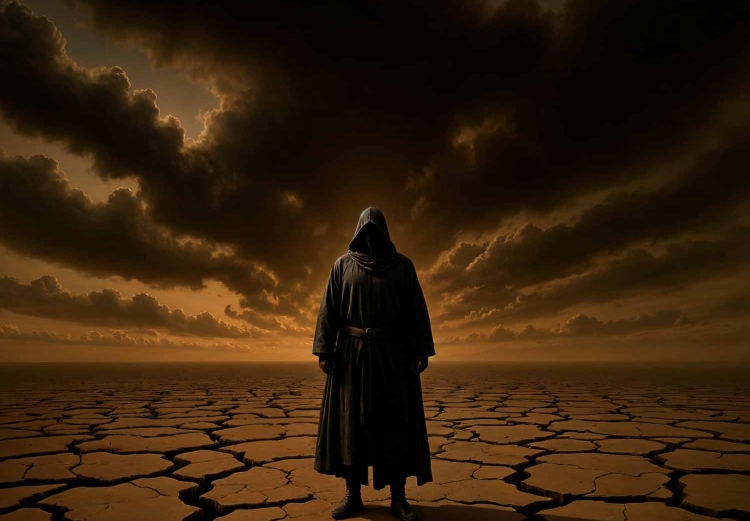
There's a particular kind of dread that doesn't come from a villain with a name.
It doesn't have a face, or a throne, or a monologue. It doesn't want anything in the way that characters want things. It doesn't scheme, or lie, or betray. And yet it stops characters dead in their tracks, turns them back, breaks them down, kills them slowly, and sometimes kills them fast. It is the land itself. The cold. The dark. The distance. The swamp that swallows your horse and then your hope. The desert that gives you nothing for a hundred miles and then gives you a mirage.
In fantasy fiction, we spend a lot of time thinking about antagonists as people. The dark lord. The corrupt king. The scheming council member who smiles too much. These are satisfying opponents because they're legible, they have intentions, and intentions can be read, outmanoeuvred, and defeated. But some of the most powerful storytelling in the genre comes from writers who understood something else entirely: that a hostile world is a kind of antagonist no character can simply outsmart, and no ending can fully resolve.
The land doesn't lose. You survive it, or you don't.
What It Means for a Setting to Push Back
Most settings are passive. They provide backdrop, atmosphere, and flavour. The inn is warm; the city is crowded; the forest is ancient and strange. These things tell us where we are, and they colour the mood, but they don't act. They don't do anything to the characters.
An antagonistic setting is different. It imposes costs.
This isn't simply about making a place dangerous. Danger alone doesn't constitute antagonism. A battlefield is dangerous, but the danger comes from the enemy, not the field. What makes a setting genuinely antagonistic is when the environment itself becomes the source of pressure: when the desert is the obstacle, not the bandits in the desert; when the mountain doesn't care whether you make it across, and that indifference is precisely what makes it so formidable.
There's a useful distinction here between setting as an obstacle and setting as an antagonist. An obstacle is something you overcome. An antagonist is something that shapes the story, that reveals character under pressure, and that leaves marks, even on those who survive.
The best antagonistic landscapes in fantasy do both.
The Waste in Tolkien: Distance as Despair
J.R.R. Tolkien understood that the most oppressive thing a landscape can do to characters is simply refuse to end.
The Dead Marshes, the Emyn Muil, the long miles of Mordor, these are not decorated with monsters at every turn. What makes them terrifying is their sheer extent. Frodo and Sam don't face a sequence of dramatic perils in the approach to Mount Doom. They face nothing. They face ash and silence and a horizon that never seems to change. The land offers no encouragement, no shelter, no sign that the journey is even possible. It just continues.
This is one of Tolkien's subtler achievements: he understood that distance, presented honestly, becomes a psychological antagonist. The question stops being can they defeat what opposes them and becomes can they keep walking. And that is, in some ways, a harder question to answer.
Mordor as a landscape is an argument that evil corrupts the world itself, that the Shadow doesn't only reside in Sauron but in the broken, barren earth over which he rules. The land has been made into a reflection of its master. To enter it is to feel, physically, what power that corruption really means.
Roshar in The Stormlight Archive: When the World Attacks on a Schedule
Brandon Sanderson's Roshar takes the antagonistic landscape to its logical extreme: here, the world attacks regularly, predictably, and without any possibility of negotiation.
The highstorms are among the most creative pieces of environmental worldbuilding in recent fantasy. These are not storms in any ordinary sense. They are continent-spanning events of such violence that they have shaped every aspect of life on Roshar, architecture, agriculture, clothing, military strategy, and the very biology of the plants and animals. Roshar's fauna retreats into shells. Its trees are shaped by the wind. Its stone is scoured clean. Nothing grows in the direction the storms come from.
What makes the highstorms function as antagonists rather than mere weather events is that Sanderson takes their consequences seriously. Characters plan around them. Characters die because they miscalculated. The storms are a constant, immovable fact of life that cannot be appealed to and cannot be stopped, and that fundamental indifference to human survival is what makes them so oppressive. The heroes of Roshar are not trying to defeat the storms. They are trying to exist in a world that is, constitutionally, hostile to existence.
This is a setting-as-antagonist at the systemic level: the world isn't just dangerous in places. It is dangerous everywhere, always, on a schedule you can predict but cannot prevent.
The most terrifying landscapes in fantasy are not the ones you stumble into. They're the ones you were born inside.
The North in A Song of Ice and Fire: Cold as Inevitability
George R.R. Martin uses winter, that most primal of antagonistic environments, with remarkable patience.
Winter is coming is the most famous phrase in the series, and what makes it work is that it functions less as a warning than as an existential condition. The Stark words aren't a threat issued by a person; they're a fact issued by the world. Winter will come. It always comes. It comes regardless of who sits on the Iron Throne or how many armies march or what clever schemes unfold in the corridors of King's Landing. The political game that absorbs most of the narrative is, at some level, a distraction from the thing that actually matters: the cold and what comes with it.
The Wall is perhaps Martin's most powerful image of setting-as-antagonist. Seven hundred feet of ice and ancient magic, stretching across the entire continent, holding back something the comfortable south has decided to stop believing in. The North beyond it is not simply cold, it is the kind of cold that kills memory, that erases purpose, that makes the human concerns of the rest of the series look very small indeed.
When Jon Snow and the Night's Watch venture beyond the Wall, the narrative register changes. The political intrigue falls away, and what's left is simpler and more brutal: survival. The land beyond the Wall doesn't take sides. It doesn't care who wins. It will kill Wildlings and crows alike, with perfect equanimity.
That equanimity is the point.
Annihilation and the New Weird: When the Land Refuses to Be Understood
Jeff VanderMeer's Annihilation, which sits in a fascinating borderland between science fiction and fantasy, gives us a different kind of hostile landscape: one that doesn't simply threaten, but transforms.
Area X is not dangerous in the way a mountain or a desert is dangerous. It is dangerous in the way that something incomprehensible is dangerous, because it operates by rules no character can identify, and survival, therefore, becomes impossible to plan for. The swamp, the coast, the tower (or is it a tunnel?), the lighthouse: each of these is familiar, and yet fundamentally wrong. The biologist who narrates Annihilation is a scientist by training and temperament, someone who categorises and documents and measures, and the horror of Area X is that it defeats those strategies entirely.
This is an extreme version of setting-as-antagonist, but it illuminates something useful: the most unsettling landscapes are the ones that don't play by the rules the characters know. When the environment is legible, characters can adapt. When it isn't, when the map stops corresponding to the territory, when the tower goes down instead of up, when the wildlife behaves in ways that have no evolutionary explanation, adaptation becomes impossible, and dread becomes the permanent condition.
VanderMeer's New Weird tradition has influenced a generation of fantasy writers who've understood that strangeness itself can be a form of antagonism.
Three Questions to Ask About Your Hostile Landscape
If you're building a setting that pushes back, it's worth being deliberate about what kind of antagonist it is.
What does the landscape cost? Not in abstract terms, but specifically. Cold costs warmth, and then fingers, and then judgment, and then consciousness. A desert costs water, and then coordination, and then rationality, and then life. The more precisely you specify the cost, the more real the antagonism feels. Vague environmental threat creates vague tension. Precise environmental threat creates dread.
What does the landscape reveal? This is where the antagonistic setting becomes more than a mere obstacle. A hostile environment is a pressure that exposes character. Frodo and Sam's dynamic in Mordor is defined by that landscape, the mutual dependence, the creeping despair, and the moments of grace that feel more meaningful for being so hard-won. What does your hostile environment reveal about your characters that a comfortable one never could?
Does the landscape have a logic? Even the most alien and hostile landscape is more satisfying when it operates by consistent rules, even if those rules are never fully explained. The highstorms on Roshar follow a schedule. The Wall obeys ancient magic with its own internal coherence. Area X is incomprehensible, but it is consistently incomprehensible. A landscape that's simply dangerous in whatever way is convenient for the plot isn't an antagonist; it's a plot device wearing an antagonist's costume.
The Indifference Is the Point
There's a final distinction worth drawing, and it's perhaps the most important one.
Human antagonists hate you. Or fear you. Or want something from you. Their opposition is, at its root, a form of relationship. You matter to them enough to make you a target.
The land doesn't hate you. It doesn't fear you. It doesn't want anything from you at all. It is simply what it is: cold, or vast, or strange, or merciless in its indifference. And there is something in that indifference that cuts deeper than malice ever could.
Malice can be negotiated with, reasoned with, or outwitted. Indifference offers none of those handholds. You cannot make the Mordor plateau care about your quest. You cannot make the highstorm pause for your army. You cannot make the North warm because winter is inconvenient.
This is why the antagonistic landscape, used well, creates a particular kind of emotional weight that a human villain rarely achieves. It reminds your characters, and through them, your readers, that the world does not arrange itself around the concerns of any individual. That survival is never guaranteed. The land was here before the story started, and it will be here after the story ends.
That is not a comfortable thing to sit with.
But it is, perhaps, a true one. And fantasy at its best doesn't flinch from truth, even when that truth has no face, and no name, and no mercy.