The Role of Loyalty in Epic Fantasy
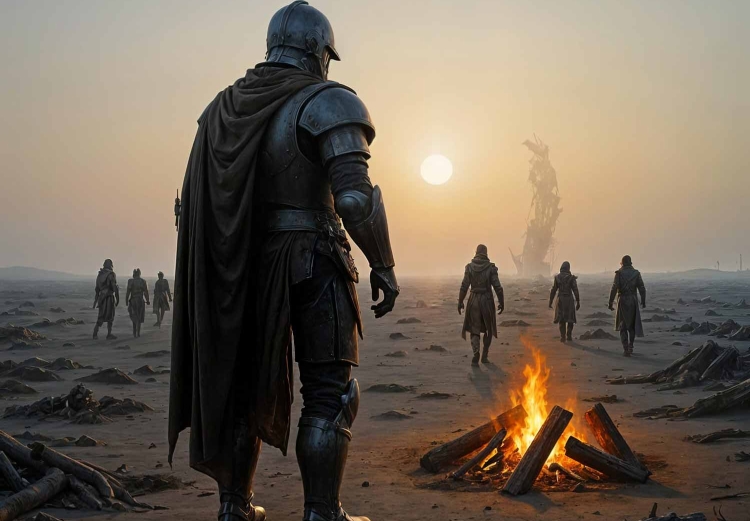
There is a question that every epic fantasy eventually gets around to asking, even when it doesn't announce itself as a question, even when it arrives disguised as plot. The question is this: when everything falls apart, who stays?
Not who is brave. Not who is powerful, or wise, or chosen, or right. Who stays. Who is still there when the cause looks lost, when the leader has made a catastrophic error, when the odds are no longer heroic but simply bad, when staying has stopped being a matter of adventure and started being a matter of cost.
That question is at the heart of what loyalty actually means in epic fantasy, and it's worth paying attention to, because the genre has a complicated relationship with it. Epic fantasy tends to build loyalty in broad strokes: the sworn oath, the fellowship forged in fire, the bond between warrior and lord that is announced on the page and then assumed to hold forever. We are told, early and often, who the loyal characters are. We are rarely shown what that loyalty is made of.
What it is made of, when the genre takes the question seriously, is something much more interesting than fidelity.
The most enduring loyalty in epic fantasy is not the kind that costs nothing. It is not the loyalty of easy allegiances, of companions who stay because the cause is righteous and the fellowship is warm and the adventure is still, for now, an adventure. That loyalty is real, and it matters, and it is worth writing. But it is not the kind that leaves a mark. The loyalty that matters, the kind readers carry out of a book and keep, is the kind that is tested until it is no longer comfortable, and survives anyway.
Think about what a genuine test of loyalty requires. It requires a situation in which leaving would be reasonable. Not cowardly or monstrous but reasonable. The leader has become someone different from the person the oath was made to. The smart and safe move is to go. But the character stays.
That is the moment that defines whether the loyalty in a story is decorative or structural. Decorative loyalty is loyalty that doesn't actually cost anything, that operates in conditions carefully designed to make staying easy. Structural loyalty is loyalty that the story puts under genuine pressure and then asks: Does it hold? And if it holds, why?
The why matters enormously. Loyalty that holds for the wrong reasons, fear, inertia, the simple inability to imagine any other life, is not admirable. It is a kind of captivity. And loyalty that holds for the right reasons, but the story never examines what those reasons are, is not really loyalty. It is a plot mechanism wearing loyalty's face.
Epic fantasy inherited its model of loyalty from a long tradition: feudal obligation, the comitatus of early medieval poetry, the idea that the bond between a lord and a retainer was not merely contractual but existential. A warrior's identity was bound up in whose man he was. To leave was not just to break an agreement; it was to unmake yourself. The oath was not something you gave. It was something you became.
There is something powerful in this, and the genre hasn't abandoned it entirely. But it has also, in its more interesting iterations, started to interrogate it. Because the old model of loyalty, loyalty as identity, loyalty as obligation, loyalty as the shape of a self that has no other shape, is not automatically heroic. It can also be a mechanism of control. It can also be how people are held in service to causes that have stopped deserving them.
The question of deserving is one that the best epic fantasy refuses to look away from. Does the cause still merit the loyalty? Does the person at the centre of it? Has the leader become someone who has spent the loyalty of their companions on something it should never have been spent on? And if so, what then? Does loyalty require you to keep paying out, or does it contain within itself some implicit limit, some point beyond which fidelity becomes complicity?
These questions don't have clean answers. They are not supposed to. They are the territory that produces the most genuinely compelling characters in the genre: not the ones who never doubt, but the ones who doubt and stay anyway, or doubt and leave, or stay until they can't and then leave at exactly the wrong moment, or leave and find they cannot go far enough to stop caring about the thing they left.
There is a particular kind of scene that epic fantasy returns to, again and again, that gets at something true about this. It is the scene in which the leader, or the cause, has failed, not ambiguously, not in a way that can be explained or excused, but genuinely, substantially failed, and the companions must decide what to do next. Not in the heat of battle, where there is no time for decision, but in the cold aftermath, where there is nothing but time and the full weight of what has happened.
What a writer chooses to do in that scene reveals everything about what they think loyalty is.
Some writers choose confirmation: the companions stay, the leader is redeemed, the failure is a crucible that produces something stronger. That is a satisfying shape. It is also often the shape that costs the least. The loyalty is preserved by removing the conditions that made it difficult. The test is passed by changing the terms of the test.
Other writers choose something harder: the companions stay not because things have improved, but because they have decided, in the full knowledge of what they know, that staying is what they are. The failure does not change the fundamental question of where they stand. That loyalty, at this level, is not a bet on the cause being good enough, but a statement about who they are and what they have chosen to be in relation to something larger than themselves.
And some writers choose the hardest thing of all: they let a loyal character leave. Not out of cowardice or betrayal, but out of a moral clarity that the loyalty has been betrayed first, that to stay would be to participate in something the original oath was never meant to cover. And then they show what that costs. Not just strategically, not just practically, but personally, the unmooring of a self that was built around a bond that is now broken.
That last choice is the one that rings truest to me. Not because leaving is always right, but because showing the cost of it, in both directions, the cost of staying past the point of rightness, the cost of leaving after the point of belonging, is the only way to make loyalty mean something beyond the word itself.
What epic fantasy understands, at its best, is that loyalty is not a feeling. It is a practice. It is a repeated choice, made under conditions that change, against pressures that escalate, in the face of a future that is never guaranteed. The characters who are loyal in the interesting sense are not loyal because they feel warmly toward their companions, or because the oath was made in a moment of high emotion, and the emotion has not yet faded. They are loyal because they keep choosing it, again and again, when the choosing is genuinely difficult.
This is why the loyalty of secondary characters is often more revealing than the loyalty of protagonists. Protagonists tend to be locked in by narrative necessity; their loyalty to the central cause is structural, because the story is about that cause and they are the ones the story follows. Secondary characters have more room. They can leave. They can defect. They can stay not because the plot requires it but because the character requires it, because something in their particular history and nature and understanding of themselves makes leaving unthinkable even when it would be reasonable.
The characters who do this tend to be the ones readers talk about decades later. They tend to be the ones who feel most true. Not because they are admirable in some uncomplicated sense, but because their loyalty is costly, and because the cost is counted honestly, and because they pay it anyway.
That is what staying when it gets hard actually looks like. Not a dramatic declaration. Not a single heroic choice at a single dramatic crossroads. A series of smaller choices, made in conditions that do not ask for heroism, that add up, over time, to something that can only be called devotion.
Epic fantasy, when it earns its scope, is the literature that understands this. The grand scale of the genre exists to create the conditions in which loyalty is genuinely tested, in which the stakes are high enough that the question of who stays is not rhetorical. The magic and the swords and the dark lords are the backdrop. The real subject has always been the same: who are you, when it costs something to be it?
That question, asked again and again across ten thousand pages and a hundred imagined worlds, has not worn out. It still arrives, in the best of the genre, with the force of something that matters. Because it does matter. Not just in the story. Outside it too, where the conditions are different, but the question is the same.
Who stays?
It is still the most interesting thing to ask.