Balancing Action and Reflection in Fantasy Stories
There is a particular kind of exhaustion that comes from a fantasy novel that never stops moving.
Not the good kind. The kind that comes from a race through the dark with something enormous behind you, where the breathlessness is part of the point. This is a different exhaustion. The kind that sets in when the breathlessness never ends. When every chapter is a battle or a betrayal or a revelation, when the world is always collapsing, and the stakes are always terminal, and the characters are always in the middle of something that demands everything from them. It is the exhaustion of a story that has confused motion with momentum, and noise with significance.
Epic fantasy is particularly prone to this. The genre runs on scale, and scale has its own gravitational pull. A world large enough to matter invites conflict large enough to fill it. Armies, empires, prophecies, catastrophes, all of it pulls toward action, toward event, toward the next disaster waiting on the other side of the chapter. And the action is genuinely good. Action is why many readers come to the genre in the first place. There is nothing wrong with a battle scene that earns its violence, or a confrontation that pays off a hundred pages of tension, or a sequence of pure forward motion that reminds you why narrative exists. The problem is not the action. The problem is the assumption that stopping is a failure.
Breathing room matters. It matters in the same way silence matters in music. The space between notes is part of the composition. The space between crises is part of the story. Strip it out entirely, and what remains is technically complete, technically continuous, technically never boring, and yet somehow hollow, because it has removed the very thing that gives the action its weight.
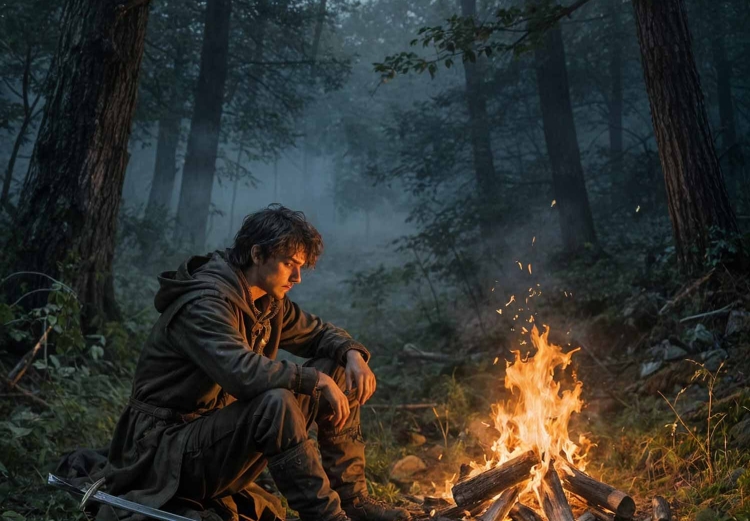
That thing is reflection. Not introspection for its own sake, not pages of interior monologue where characters explain their feelings in careful sentences, but the quieter moments in which the story acknowledges what has happened, and lets both the characters and the reader sit with it. The scene after the battle, before the next one. The morning in a village that is not yet under threat. The conversation that has no tactical purpose. The moment where someone stares at a fire and does not say anything, and the silence is legible, and what it contains is everything the previous hundred pages have been building toward.
This is where character actually lives. Not in action, though action reveals character. Character lives in reaction, in the unguarded moments, in the things people do when no one is watching, and the plot has briefly released its grip on them. A hero who only exists in crisis is a function, not a person. We know what they can do. We do not know who they are. And the distinction matters, because we do not grieve functions when they die. We grieve people.
The fantasy writers who understand this, the ones whose books readers carry around for years after finishing them, tend to be writers who trust the quiet. They allow their characters to be somewhere uneventful and notice things there. They let conversations wander into territory that is not strictly necessary for the plot. They give their worlds texture that serves no tactical purpose: the way a particular city smells, the rhythm of a meal taken without ceremony, a small kindness that changes nothing and means everything. These details do not advance the story in any measurable way. They are the story. They are what makes the action matter when it comes.
There is a related problem, which is the reflexive use of revelation as a substitute for depth. The revelation, the unmasking, the twist, the secret that changes everything, has become so standard in the genre that many writers use it as the primary mechanism for emotional impact. Something happens, and then something is revealed about that thing, and the revelation recontextualises the thing, and the reader is supposed to feel the full force of both at once. This can work. It can work extraordinarily well. But it requires the story to have built something worth recontextualising. A revelation that lands on unexplored ground does not produce resonance. It produces surprise, which is smaller, and fades faster.
The quiet scenes are what build the ground. The unhurried scene early in a book where two characters share a meal and talk about something inconsequential, this is not filler. This is an investment. When those characters are later separated by war, or betrayal, or death, the reader feels it not because the story announces that it is sad, but because the reader has sat at that table. They have been in the room. The grief is not explained to them; it is something they arrive at from the inside, because the inside has been made habitable.
This is why pacing in fantasy is not simply a question of fast versus slow. Pacing is a question of where, within the story, you allow the reader to breathe. A fast-moving narrative with well-placed quiet moments can sustain momentum across a thousand pages without ever losing the reader's trust. A narrative that simply accelerates and treats every pause as a problem to be solved by adding more tends to produce the opposite effect: the reader stops caring, not because the story is boring, but because it has stopped giving them reasons to care. Caring takes time. It requires a certain quality of attention that cannot be sustained at a sprint.
The genre's fondness for sequels and series makes this more acute, not less. A single novel has a natural shape, and within that shape the writer can find the rhythms that serve the story. A series of five or seven or ten novels stretching across thousands of pages faces a different problem: how to sustain significance across a distance that invites entropy. The solution most writers reach for is escalation, each book raising the stakes, each instalment threatening something more vast and terrible than the one before. Escalation works for a while. But escalation without consolidation eventually rings hollow, because the reader has lost track of what any of it means to the people it is happening to.
The series that survive, the ones that readers return to and reread and press into the hands of people they want to understand them, are almost always the ones that make time, throughout their length, for the unhurried. For the book in the middle of the series that is quieter than the others, that deepens rather than expands, that asks the characters what they have learned and does not rush past the answer. For the chapter that is nothing but two people walking through a landscape and talking, and no one dies, and nothing explodes, and at the end of it, the reader knows something about those people that all the battles in the world could not have given them.
There is no formula for this. The right ratio of action to reflection is not a number. It is a feel, the same feel that a skilled musician has for silence. It comes from understanding that the point of the action is not the action. The point of the action is what it costs, and what it changes, and what it means to the people it happens to. And that meaning can only be established in the moments when the action has stopped.
When it works, when a fantasy story has found that balance, when it knows when to move and when to stay still, the result is something that readers describe with words that are not about plot. They do not say it was exciting, or thrilling, or propulsive. They say it felt real. They say they cared. They say they did not want it to end, which is a different thing from saying they wanted to know what happened next. Wanting to know what happens next is curiosity. Not wanting it to end is attachment.
Attachment is built in the quiet.
That is what breathing room actually does. It is not a rest between sequences of importance. It is its own kind of importance, the kind that does not announce itself, that does not ask to be recognised as significant, that simply sits with the characters and the reader in an unguarded moment and does its work there.
The action is what makes fantasy feel vast. The quiet is what makes it feel true.
Both of those things are necessary. The genre is at its best when it knows how to hold them together.