Why Small Personal Stakes Make Big Conflicts Work
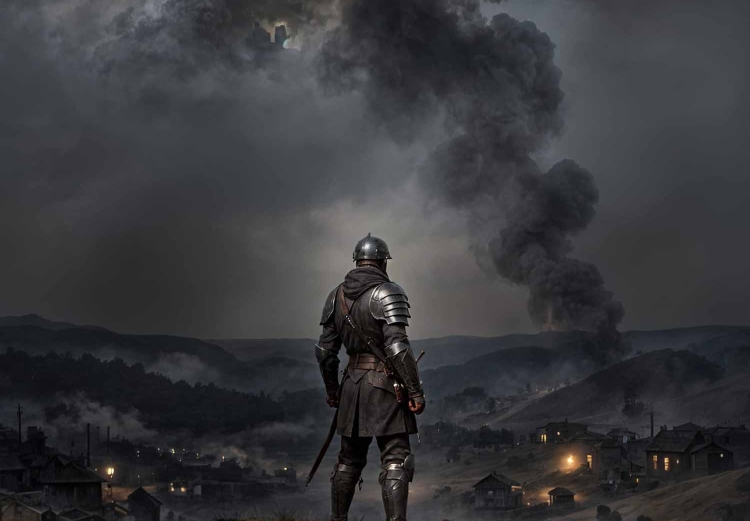
There is a paradox at the heart of epic fantasy that most writers eventually bump against, even if they cannot immediately name it.
The paradox is this: the bigger the conflict, the harder it is to feel. A war that threatens a single village is easier to inhabit than a war that threatens every village in every kingdom across a continent. A character who might lose their home is closer to us than a character who might lose the world. Scale, which the genre reaches for almost instinctively, has a strange way of working against the very thing it is supposed to create. It is meant to raise the stakes. Very often it empties them.
This is not a failure of imagination. It is a failure of attachment. And the solution is not to shrink the conflict but to understand what actually makes a conflict feel significant to the person reading it.
The answer is almost always small. It is almost always personal. It is almost always a single person standing in the path of something enormous, and the thing that matters is not the enormity but the person.
Epic fantasy knows this, at least in theory. It knows that the reader needs a point of entry, a character through whom the larger events are experienced and measured. What it sometimes forgets is that this is not merely a structural convenience, a vehicle for exposition and scene-setting, but the actual emotional engine of the story. The reader does not care about the fate of the kingdom in the abstract. They care about the fate of the kingdom because they have come to care about the person who lives in it, who loves someone in it, who has something in it worth losing. Take away the small personal stake, and the big conflict becomes a weather event. Terrible and impersonal and impossible to grieve.
Think about the conflicts that stay with you after you close a book. They are rarely the ones where the entire world was at stake in a way that could be expressed as a number, a body count, a measure of acreage lost or civilisations collapsed. They are the ones where you knew, with absolute intimacy, what a specific person stood to lose, and where you spent enough time with that person to feel the loss as something real. The battle that matters is not the one with the largest army. It is the one where the character fighting in it is fighting for something you have watched them love.
This is where the genre's appetite for escalation can quietly undo itself. There is a logic to escalation that seems unanswerable: if the first book ends with the hero saving a city, the second book must end with the hero saving a country, and the third with the hero saving the world. Each instalment must threaten something larger than the last. This is how series maintain tension, or so the thinking goes. But what actually happens, in practice, is that the reader's sense of what the stakes mean tends to diminish in proportion to their size. Not because the reader is unimaginative, but because the escalation has outrun the attachment. We have not been given time to care about the country or the world in the way we once cared about the city. The macro scale has expanded while the human scale has remained constant or, worse, been neglected in favour of scenes that demonstrate the scope of what is at risk.
The writers who understand the stakes tend to resist this. They understand that the question is never how large can we make this conflict, but how much can we make the reader feel the cost of it. And cost is intimate. Cost is a name, a face, a relationship, a room that someone will not come home to. It is not a number on a map.
This is why the personal and the political are not in tension in fantasy, even though they are often treated as if they are. There is a school of thought, mostly unspoken but surprisingly durable, that the personal is small and the political is large, and that large is more important, and therefore a story that spends time on personal relationships at the expense of geopolitical manoeuvring is a story that has got its priorities wrong. This gets it exactly backwards. The personal is not a distraction from the political. The personal is what gives the political its gravity. A reader who understands, from the inside, what a particular character has to lose in a particular war is a reader who will feel that war in a way that no amount of tactical detail or dynastic complexity can produce on its own.
What the small personal stake does, at its best, is create a node of meaning within the larger conflict. It gives the reader somewhere to stand. A place from which the enormity can be perceived, and measured, and understood as something that matters to someone, which is the only way anything can truly matter in fiction. The destruction of a city is reported. The destruction of someone's home, someone we know, someone whose life in that home we have inhabited, even briefly, even in passing, is felt.
This is not a plea for small stories. Epic fantasy is right to be large. The largeness is part of what makes it what it is. The empires and the armies and the prophecies and the catastrophes are not mistakes. They are the genre's natural habitat, and they have produced some of the most sustained and serious imaginative work in contemporary literature. The argument is not against scale. It is for a scale that is anchored. A scale that has been given somewhere to stand. Scale that has taken the trouble to find a single face within the vastness and make sure the reader knows that face well enough to fear for it.
The most effective technique for this is also the simplest: give your character something specific to protect, and make sure the reader has seen that thing clearly before it is threatened. Not an abstraction. Not a principle or a legacy or a way of life, though those things can follow once the specific thing has been established. Something concrete. A person. A place. A promise. A grief that has not yet resolved. An incomplete relationship. Something that exists at a scale the reader can hold in their hands.
There is a corresponding discipline required, which is the willingness to return to that small stake even when the larger conflict is at its most demanding. The mistake many writers make is treating the personal stakes as setup, as something established in the early chapters that can be invoked thereafter by reference. But stakes do not sustain themselves by reference alone. They need to be renewed. The reader needs to be returned, periodically, to the thing the character is fighting for, so that the connection between the small personal truth and the large political event remains alive throughout the length of the story, not merely present at the beginning and assumed at the end.
When this is done well, something interesting happens to the conflict itself. It stops being a backdrop and becomes a crucible. The war does not just threaten the characters; it reveals them. It creates conditions under which the small personal stakes are tested in ways that peace cannot produce. What does a person become when the thing they love is genuinely at risk? What do they compromise, and what do they refuse to compromise? What does it cost them to hold the line, and what kind of person survives the holding? These are not political questions. They are human ones. But they can only be asked with full force inside a conflict large enough to make the cost real. The small and the large need each other. The personal stake is the lens, and without a lens, the large conflict is just light.
The reader does not come to epic fantasy to hear about the world ending. They come to feel, in a way that their ordinary life cannot provide, what it might mean to stand in the path of something enormous and choose. The choice only matters if something is at stake. The stake only matters if it is specific. The specific only matters if it has been loved.
That is what small personal stakes actually do. They make the reader capable of caring. And a reader who cares will follow a conflict to the end of the world and beyond, not because the world is worth saving in the abstract, but because they have met someone who lives in it.